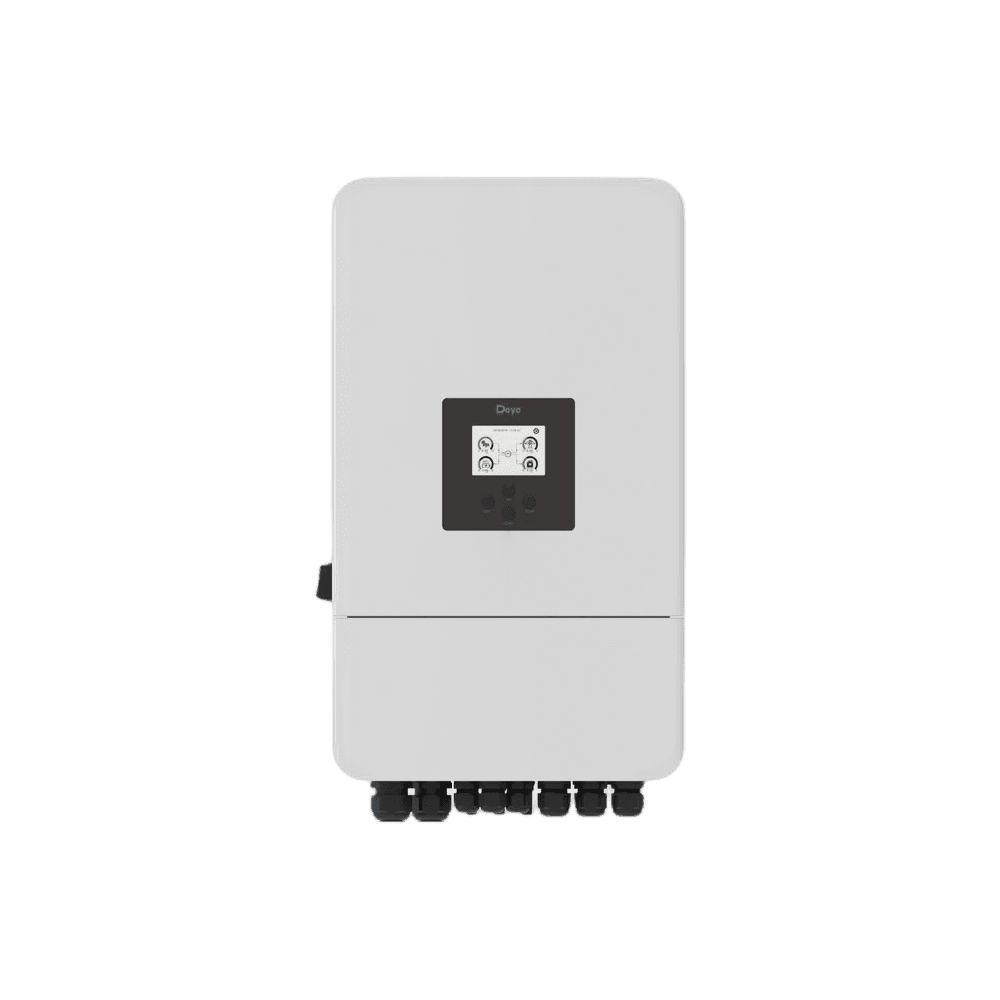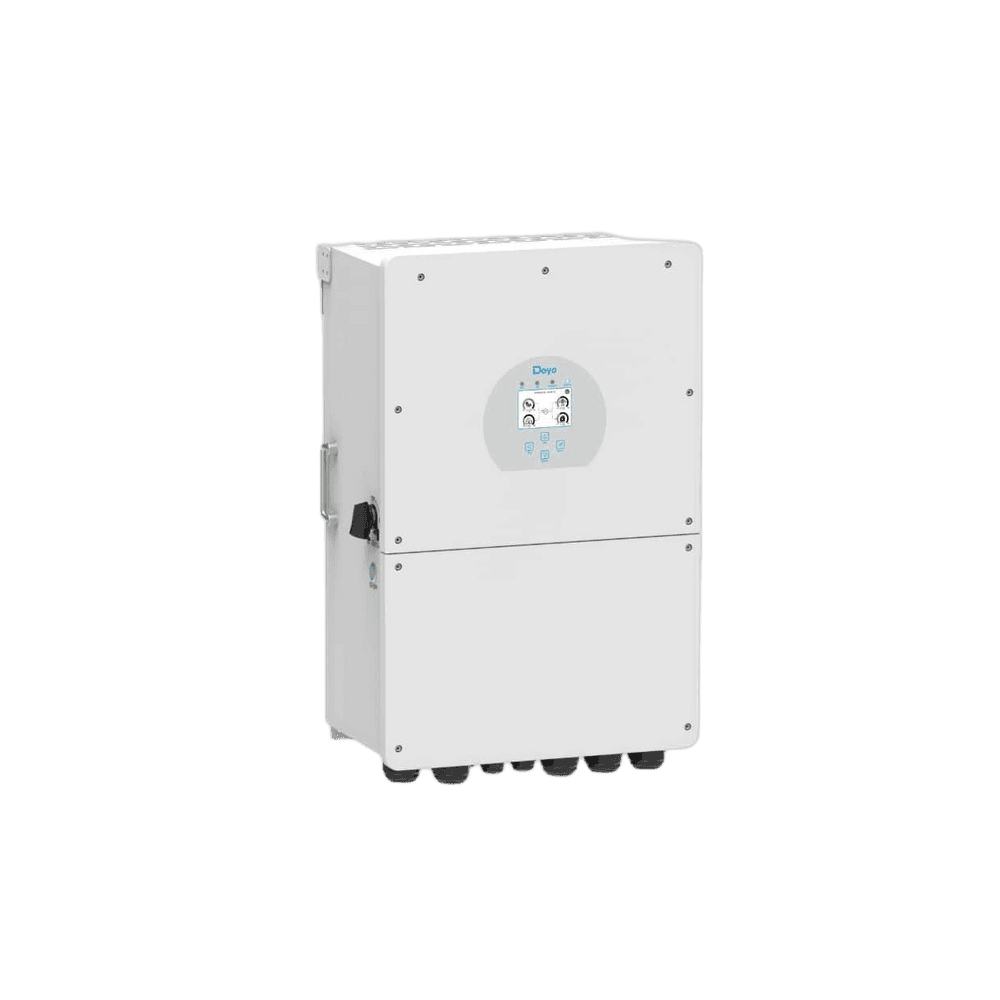
We list 134 solar inverters, each with a published spec record, from 300 W to 136 kW. Five rows separate them: phase, battery, efficiency, derating and noise.
A plural search — inverters, not inverter — is a search for a range. The person typing it does not want one model yet; they want to see what exists and then narrow it. This page is written in that order. We list 134 solar inverters, every one of them carrying a single published spec record, and what follows are the rows that actually separate them rather than the marketing names.
The name itself is not fixed either: buyers write inverter, solar converter and solar inverter for the same box. We took the naming apart separately in What Is a Solar Inverter?. Here the question is the next one: which of them?
We are an authorised distributor of Deye products. The catalogue today is 176 products — 134 inverters, 35 batteries and 7 solar air conditioners — and each inverter maps to exactly one record in our spec file: no listing without a record, no record without a listing. Every figure below is lifted from that file.
If you have a monthly consumption figure and a photo of your meter board, send both on WhatsApp +971 4 255 0887 or by email to sales@deyeinverters.net and we will read the matching rows back to you.
The whole range: 300 W to 136 kW
The smallest record states a rated AC output of 300 W — the SUN-M30G4 microinverter, which mounts behind a single panel. The largest states 136,000 W, the three-phase SUN-136K-G01P3. Between them the rest sits like this: 18 records below 3,000 W, 32 from 3,000 to under 6,000, 24 to under 10,000, 22 to under 20,000, 17 to under 50,000, and 21 at 50,000 and above. Once you know your consumption you are not choosing from 134 but from twenty or thirty.
Four families, each answering a different question
The 134 records split into four families, and what separates them is not size but what the device accepts at each end: whether it takes a battery, and whether it can be stacked in parallel with its twin.
| Family | Records | Rated output range | Battery type row | Units in parallel |
|---|---|---|---|---|
| String (G) | 70 | 1,000 – 136,000 W | Not Applicable | Not Applicable |
| Hybrid (SG) | 49 | 3,000 – 80,000 W | Lead-acid or lithium-ion on 32, lithium-ion on 17 | 10 on 34 records, 16 on 15 |
| Micro (M) | 12 | 300 – 2,250 W | Not Applicable | 3 to 17, by model |
| Off-Grid (OG) | 3 | 3,600 – 6,000 W | Lead-acid or lithium-ion | 16 |
Three rows summarise what each family does. The 70 string records are the only ones that publish zero-export support as Yes — all seventy of them — and they state no battery, no generator and no AC coupling. The 49 hybrids state six programmable charge and discharge periods, generator support Yes (Diesel), and AC coupling Yes. The three off-grid records share the battery and generator rows with the hybrids and state 16 units in parallel. The 12 microinverters mount behind the panels themselves, and their rows say so: IP67 on all twelve instead of IP65, noise below 25 dB, and a maximum efficiency of 96.5 per cent on every one of them.
Phase: the row that deletes half the range
Before any other comparison, one row cuts the range roughly in half: the grid connection form. Seventy-two records print 3L+N+PE, meaning three-phase, and sixty-two print L+N+PE, meaning single-phase. The single-phase ceiling is 16,000 W — the SUN-16K-SG01LP1, with three MPPT trackers and noise below 50 dB — while three-phase begins at 3,000 W with the SUN-3K-SG05LP3. Everything between 3 and 16 kW therefore exists in both forms, and anything above 16 kW is three-phase only. What decides is the meter on your wall, not the inverter, and we took that apart in Single Phase vs Three Phase Inverters.
Battery or no battery: 52 records against 82
The battery type row reads Not Applicable on 82 records — the 70 string units and the 12 micros — and on the remaining 52 it comes in exactly two forms: lead-acid or lithium-ion on 35 records, and lithium-ion on 17. The second form is a restriction rather than a preference: those are the high-voltage SG01HP3 records, whose battery voltage range starts at 160 V and runs to 700 V and above, while the low-voltage models state 40–60 V. And if what you want is power during an outage, you are inside the 52 and not outside it: anti-islanding protection reads Yes on 131 records, meaning the unit disconnects when the grid goes, and what keeps the house lit afterwards is the battery.
Efficiency: 96.5 to 98.8 per cent
The highest maximum efficiency in the range is 98.8 per cent, stated on eight records only — all string inverters rated 90 kW and above, from the SUN-90K-G03 to the SUN-136K-G01P3. The most repeated value is 97.6 per cent on 48 records, 45 of them hybrids, followed by 97.5 per cent on 18. The lowest is 96.5 per cent on the 12 micros. The spread from top to bottom is 2.3 percentage points, and it weighs differently on a hundred-kilowatt array than on a house roof: on the first it is counted annually in megawatt-hours, on the second it sits below several other rows on this page.
Heat: the number that matters is not the ceiling
Every record in the range ends its operating temperature at 60 or 65 °C: -25 to 60 on 52 records, -40 to 60 on 52, -25 to 65 on 18, and -40 to 65 on 12. But the ceiling is not what you feel in July. What you feel is the derating start temperature, and it reads 45 °C on 113 records — output starts falling at 45, not at 60. On 21 records the figure is not stated at all, and those are records we do not hold the number for, so we do not write one. The rest of the environmental rows are steady across the range: IP65 on 122 records and IP67 on the 12 micros, permissible humidity 0–100 per cent on all 134, and a permissible altitude of 2,000 m on 63 records, 3,000 m on 33 and 4,000 m on 38.
What that 45 °C figure means on a rooftop in Riyadh or Jeddah is worked through in Best Solar Inverter for a Riyadh Villa.
Noise: the row that decides where it can be mounted
The noise row runs from below 25 dB on the 12 micros to below 65 dB on 17 records. In between: below 30 dB on 12 records, all of them single-phase hybrids from the SG04LP1 and SG05LP1 families; below 35 dB on 32 records, all string inverters; and below 55 dB on 33. Cooling explains the order — natural cooling on 59 records, intelligent air cooling on 71, and smart cooling on 4. If the mounting wall is shared with a bedroom, this row outranks efficiency for you, which is why it has a page of its own: The Quietest Solar Inverter for an Apartment.
So which is best? Five cases, five answers
Best is not a property of a device; it is the outcome of a case. The table below takes five common ones and puts a record from the range against each, named by the rows that qualified it rather than by adjectives.
| The case | Model | The rows that qualified it |
|---|---|---|
| A balcony or a small roof, two panels | SUN-M60G4 | 600 W, single phase, two trackers, IP67, under 25 dB, up to 8 units in parallel |
| A single-phase home that wants a battery | SUN-5K-SG04LP1 | 5,000 W, two trackers, 40–60 V battery, 120 A maximum charge current, six periods, under 30 dB |
| A large villa on a single-phase meter | SUN-16K-SG01LP1 | 16,000 W, the single-phase ceiling of the range, three trackers, under 50 dB |
| A three-phase villa with a high-voltage battery | SUN-12K-SG01HP3 | 12,000 W, 3L+N+PE, lithium-ion only over 160–700 V, two trackers |
| A farm or factory with no storage | SUN-110K-G03 | 110,000 W, six trackers, 98.8 per cent maximum efficiency, zero-export support Yes |
What this page does not contain
We do not sell solar panels: the catalogue is 176 products and not one of them is a module, so anything about the panel — its wattage, its open-circuit voltage — comes from its own datasheet and not from us. And we do not write a figure a record does not state: zero-export support is unstated on 64 records, ground fault monitoring is unstated on 124, and anti-PID reads Optional on 70 and unstated on 64. An unstated row is not a No and not a zero; it is a number we do not hold.
If you would rather start from the range itself than from a general rule, the full list is on the Deye inverters page, each model with its record attached. Or send your consumption and meter type on WhatsApp +971 4 255 0887 and we will shortlist three records with their figures instead of a hundred and thirty-four.
Frequently Asked Questions
What is the difference between an inverter, a solar converter and a solar inverter?
What is the best solar inverter for an average home?
How many inverters do you sell?
Do I need a three-phase solar inverter?
What is the highest efficiency in the range?
Do these inverters cope with Gulf heat?
Ready for a personalized quote?
WhatsApp us — average reply time under 15 minutes.