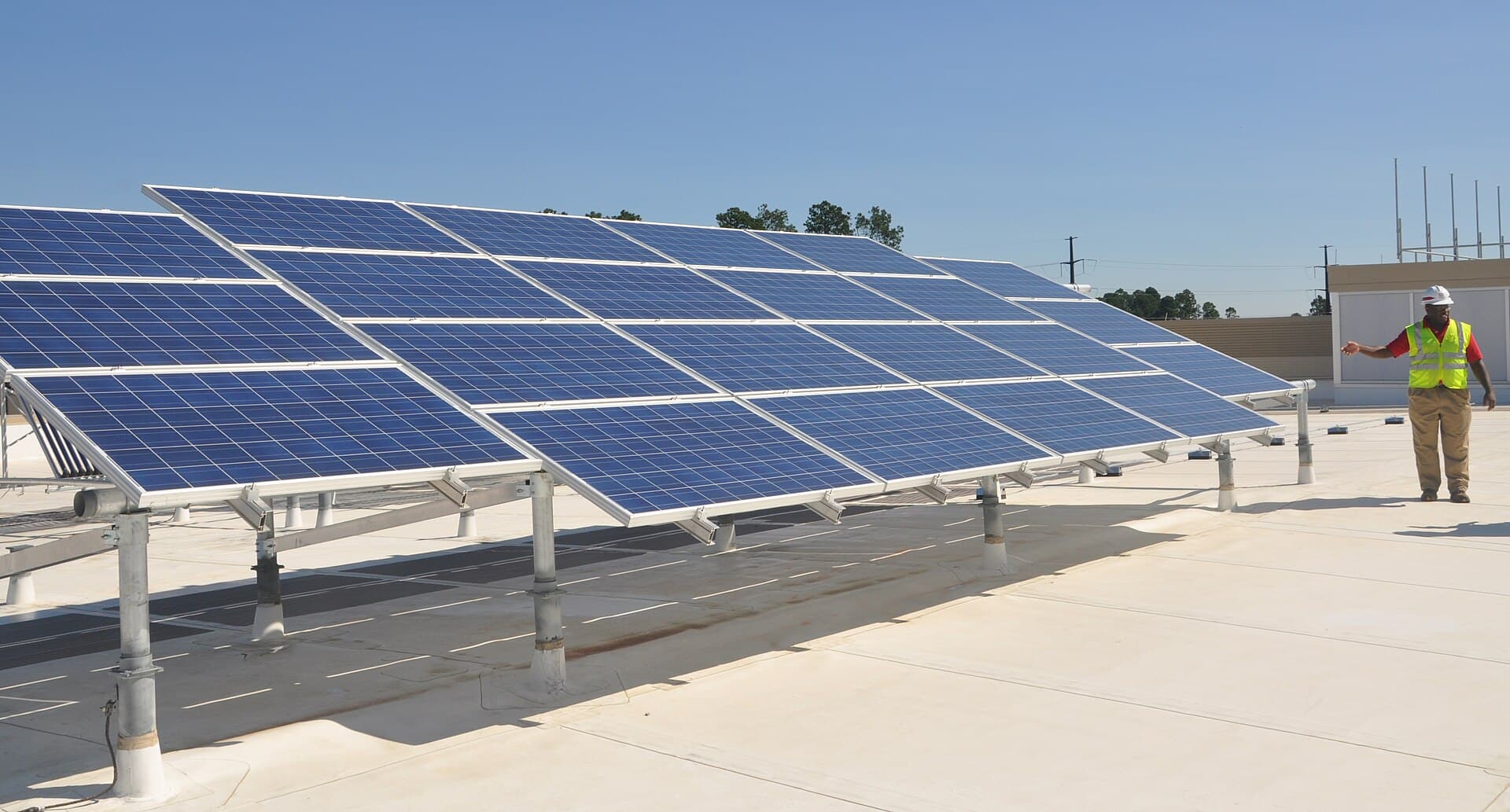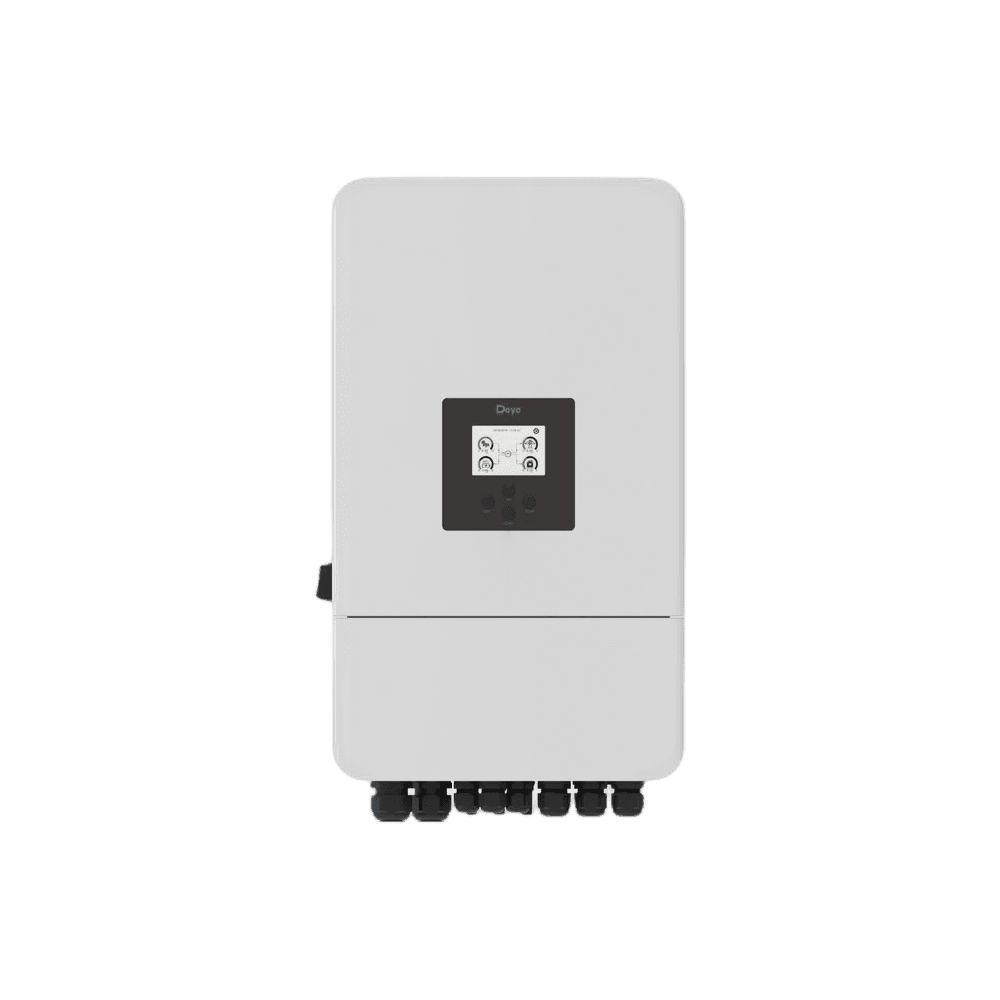
Solar inverter, inverter, solar power converter — names for one device that turns your panels' DC into usable AC. A from-scratch explainer built on 134 Deye spec records: efficiency, MPPT, protection.
If you searched for a solar inverter and landed on a page that calls the same box an inverter, a PV inverter or a solar power converter, none of those is a different product. They are four names for one device, and the device has one job: take the direct current coming off your panels and turn it into the alternating current your building and your meter actually run on.
We are an authorised distributor for Deye products, and this page is written from the same spec records we publish — 134 Deye inverter records — not from a brochure. If you are holding two quotes and want the numbers read before you sign, send both model names on WhatsApp +971 4 255 0887 or by email at sales@deyeinverters.net.
What a solar inverter actually does
A solar panel does not produce the electricity you use. What comes out of it is direct current (DC) at a voltage that moves with sunlight and panel temperature, while everything in the building — the air conditioning, the fridge, the utility meter — runs on alternating current (AC) at a fixed voltage and frequency. The inverter is the device that sits between the two and performs that conversion.
The numbers make it concrete. On the SUN-5K-SG04LP3, maximum PV input voltage is 800 V DC and the tracking window is 200–650 V, while rated output voltage is 220/380 or 230/400 V AC at a rated grid frequency of 50 or 60 Hz. That is the whole conversion in two lines of a spec sheet: a moving DC voltage in, a fixed AC voltage out.
What changes after that is scale. The smallest record in the range is the SUN-M30G4 microinverter: 300 W rated output, 1.85 kg, and 420 W maximum PV input. The largest is the SUN-136K-G01P3: 136,000 W rated output, 103 kg, and up to 204,000 W of panels spread across eight trackers. The job is identical at both ends.
How much is lost in the conversion?
No conversion is free, and the right question is how much. Every one of the 134 records states two efficiency figures, not one. The first is maximum efficiency — the best the unit reaches at a single operating point. The second is European efficiency, a weighted average across different load levels, which is closer to a real operating day. Across all 134 records the European figure is lower than the peak figure without a single exception, which is reason enough to read it first.
| Model | Family | Max. efficiency | European efficiency |
|---|---|---|---|
| SUN-M100G4 | Micro (M) | 96.5% | 96.0% |
| SUN-1.5K-G04P1 | String (G), single-phase | 97.3% | 96.9% |
| SUN-5K-SG04LP3 | Hybrid (SG), three-phase | 97.6% | 97.0% |
| SUN-100K-G03 | String (G), three-phase | 98.8% | 98.2% |
Across the whole range, maximum efficiency spans 96.5% to 98.8% and European efficiency spans 96.0% to 98.2%. The low end is the microinverter; the high end is the large three-phase string units — eight records state 98.8%, from the SUN-90K-G03 to the SUN-136K-G01P3.
MPPT: the part that makes it more than a converter
If a solar inverter only changed the shape of the current, it would be a converter and nothing more. It does something else first: it searches, moment by moment, for the voltage and current point at which the array delivers the most power, and holds the unit there. That is maximum power point tracking, and all 134 records state a tracking efficiency above 99%.
The number of trackers varies by model: 15 records have one, 83 have two, 8 have three, 16 have four, 7 have six and 5 have eight. The window each tracker works inside moves with scale — 25–55 V on the SUN-M100G4, 70–500 V on the SUN-1.5K-G04P1, 200–650 V on the SUN-5K-SG04LP3, and 200–850 V on the SUN-100K-G03. Start-up voltage follows the same window: 20 V on the SUN-M100G4 microinverter, 250 V on the SUN-90K-G03.
Four families, and what each one adds
Our records split the range into four families: string inverters (G) at 70 records, hybrids (SG) at 49, microinverters (M) at 12, and off-grid units (OG) at 3. What separates them is not the quality of the conversion but what the device is allowed to connect to.
Of the 134 records, 52 state a battery type — 35 as lead-acid or lithium-ion, 17 as lithium-ion — and the same 52 state diesel generator support. Those are the hybrid and off-grid families together. The remaining 82 state 'Not Applicable' on the battery line: they convert, they do not store. Forty-nine records, all hybrids, state AC coupling support. Battery voltage splits the hybrids into two schools: 34 records at 40–60 V, the rest on high-voltage ranges reaching 160–1000 V.
| Family | Records | What the spec sheet adds | Example |
|---|---|---|---|
| String (G) | 70 | No battery line, no generator line | SUN-100K-G03 |
| Hybrid (SG) | 49 | Battery, diesel generator, AC coupling | SUN-5K-SG04LP3 |
| Micro (M) | 12 | IP67, isolated topology, weight from 1.85 kg | SUN-M100G4 |
| Off-grid (OG) | 3 | Up to 16 units in parallel; the only three records with no anti-islanding line | SUN-5K-OG01LP1 |
What all 134 records say about protection
Some figures do not separate one model from another because they are the same across the range, and knowing them saves you a comparison that has no answer:
- Current total harmonic distortion below 3% on all 134 records.
- Maximum power point tracking efficiency above 99% on all 134.
- Permissible ambient humidity of 0–100% on all 134.
- Enclosure rating of IP65 on 122 records and IP67 on 12 — nothing in the range sits below IP65.
What does differ is heat and electrical safety. Operating temperature range comes in four forms: −25 to 60 °C on 52 records, −40 to 60 °C on 52, −25 to 65 °C on 18, and −40 to 65 °C on 12. A total of 113 records state that thermal derating begins at 45 °C, while 21 records state no derating start temperature at all — and where no figure is stated we do not invent one. A DC switch is stated on 122 records, residual current detection on 119, and anti-islanding protection on 131 of 134; the remaining three are the off-grid models, which do not connect to a grid in the first place.
A note on the Arabic name, because it decides who finds this page
In Arabic the same device carries four names, and the choice is commercial rather than linguistic. العاكس is the formal Arabic noun and it is what appears in our spec tables. انفرتر is the transliteration that Gulf buyers actually type into the search box, and it is what our page titles are built on. انفيرتر is the same transliteration with an extra letter. And محول طاقة شمسية — 'solar power converter' — is a fourth, valid only with the full qualifier attached, because the first word on its own means a transformer or a charger in Arabic and has nothing to do with what we sell.
The practical point: if two quotes reach you under two different names, they are quotes for the same device. What you should compare is the figures above — European efficiency, tracker count and window, the battery line, the temperature range — not the word on the cover.
Now that you know what it is, how do you size it?
Sizing is a separate question and we have two pages on it: how to size a hybrid solar inverter for a Saudi villa and how to choose the right solar inverter for your home. In short, the figures that settle the choice are rated output power, maximum PV input power, the grid connection form — 62 of the 134 records are single-phase (L+N+PE) and 72 are three-phase (3L+N+PE) — and whether you need a battery line at all.
If you are still comparing two quotes, send both model names on WhatsApp +971 4 255 0887 and we will read you the lines that separate them straight from our records.
Frequently Asked Questions
What is the difference between a solar inverter, an inverter and a solar power converter?
What is the difference between maximum efficiency and European efficiency?
How many MPPT trackers do I need?
Does every solar inverter accept a battery?
Will a solar inverter cope with summer heat?
How do I know whether I need a single-phase or three-phase model?
Ready for a personalized quote?
WhatsApp us — average reply time under 15 minutes.
Related Products
Related Articles
Best Solar Inverter for Saudi Homes 2026: Complete Buyer's Guide

How to Size a Hybrid Solar Inverter for a Saudi Villa (2026 Guide)
How to Program a Deye Solar Inverter: Every Setting and the Limit Behind It