Step-by-step hybrid inverter sizing guide for Saudi villas in 2026 — handle multi-AC loads, battery, and generator backup. Free WhatsApp sizing in 15 minutes.
A hybrid solar inverter that's too small will trip every time three split ACs kick in. One that's too big wastes 20–30% of your capital. Sizing correctly is the single highest-leverage decision you make when going solar in Saudi Arabia — and it's the part most installers rush.
This guide walks you through the exact calculation we use at deyeinverters.net to size a Deye hybrid inverter for a Saudi villa, step by step, with real load profiles from villas in Riyadh, Jeddah, and Dammam. By the end you'll know exactly what kW rating, battery capacity, and panel array your home needs.
📞 Don't want to do the math? Send your latest SEC bill to WhatsApp +971 4 255 0887 and we'll size your system for free in under an hour.
What "sizing" actually means (and why most people get it wrong)
When people say "size the inverter," they usually mean one number — the kW rating. But a hybrid inverter has to handle four different sizing constraints simultaneously:
- Continuous power output (kW) — must cover your average daytime load.
- Peak / surge capacity (kW for 5–10 seconds) — must handle AC compressor inrush.
- PV input capacity (kW DC) — must accept your panel array.
- Battery interface (kW charge/discharge) — must match the battery you'll pair it with.
Get any one of these wrong and the system underperforms. The good news: once you know your average daily kWh, the rest is mechanical arithmetic.
Step 1 — Find your daily kWh consumption
The easiest method: check your last 12 months of SEC bills and divide by 365. Most Saudi villas have an annual variation of 2–3× between the cool months (December–February) and the peak summer (June–September), so use the summer average, not the yearly mean — that's what your inverter has to handle.
| Saudi villa type | Typical summer monthly kWh | Daily kWh equivalent |
|---|---|---|
| 2-bedroom apartment / small villa | 800 – 1,400 | 27 – 47 |
| 3-bedroom mid villa, 2 ACs | 1,500 – 2,500 | 50 – 83 |
| 4–5 bedroom villa, 3–4 ACs | 2,500 – 4,500 | 83 – 150 |
| Large villa with pool + 5+ ACs | 4,500 – 8,000 | 150 – 270 |
| Compound / multi-villa | 8,000+ | 270+ |
If you don't have your bills handy, log into the SEC self-service portal (Mobushir / موبشّر) and download the consumption history.
Step 2 — Calculate your simultaneous peak load
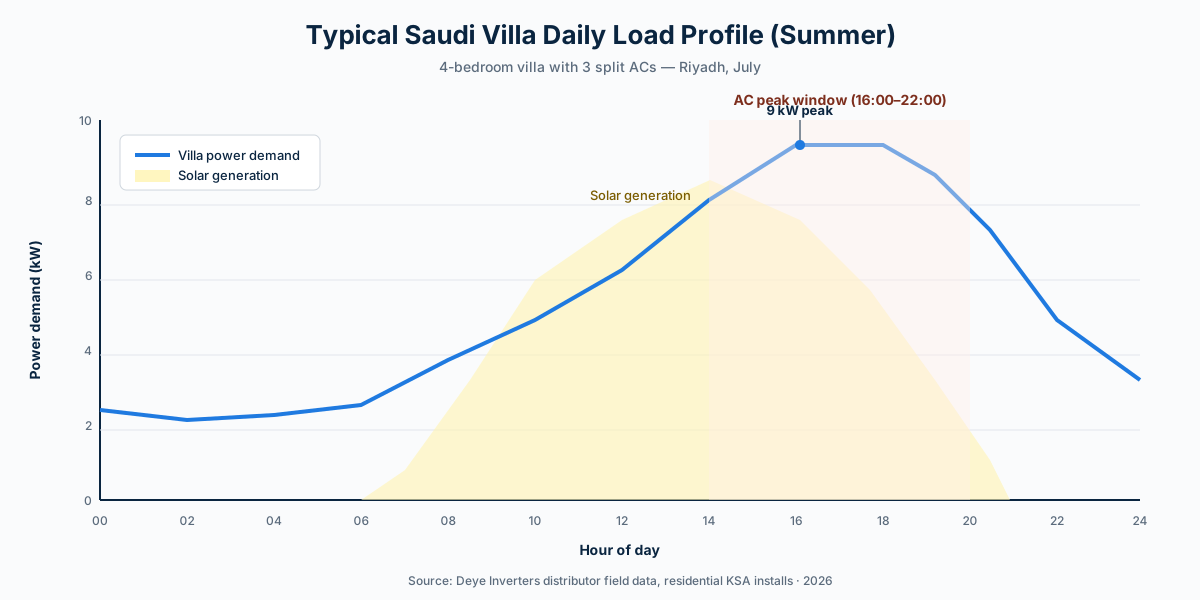
This is the most-skipped step. The inverter has to power everything that runs at the same time, not the average. In a Saudi villa during a 4 pm summer afternoon, that often includes:
| Appliance | Typical wattage | How many run simultaneously |
|---|---|---|
| Split AC (1.5 ton) | 1,800 W | 2–4 in a typical villa |
| Refrigerator | 200 W | 1–2 |
| Freezer | 200 W | 0–1 |
| Washing machine | 800 W | 0–1 |
| LED lights (entire house) | 300 W | always on |
| TV + electronics | 250 W | 1–2 |
| Pool pump | 1,100 W | 0–1 |
| Cooking (induction / oven) | 1,500–2,500 W | 0–1 |
| Water heater | 2,000 W | 0–1 |
| EV charger (Level 2) | 7,000 W | 0–1 |
For a typical 4-bedroom Saudi villa with three ACs running, refrigerator, freezer, lights, TV, and washing machine on:
3 × 1,800 + 200 + 200 + 800 + 300 + 250 = 6,950 W ≈ 7 kW
Plus a 30% safety margin for AC compressor inrush surge: ~9 kW peak.
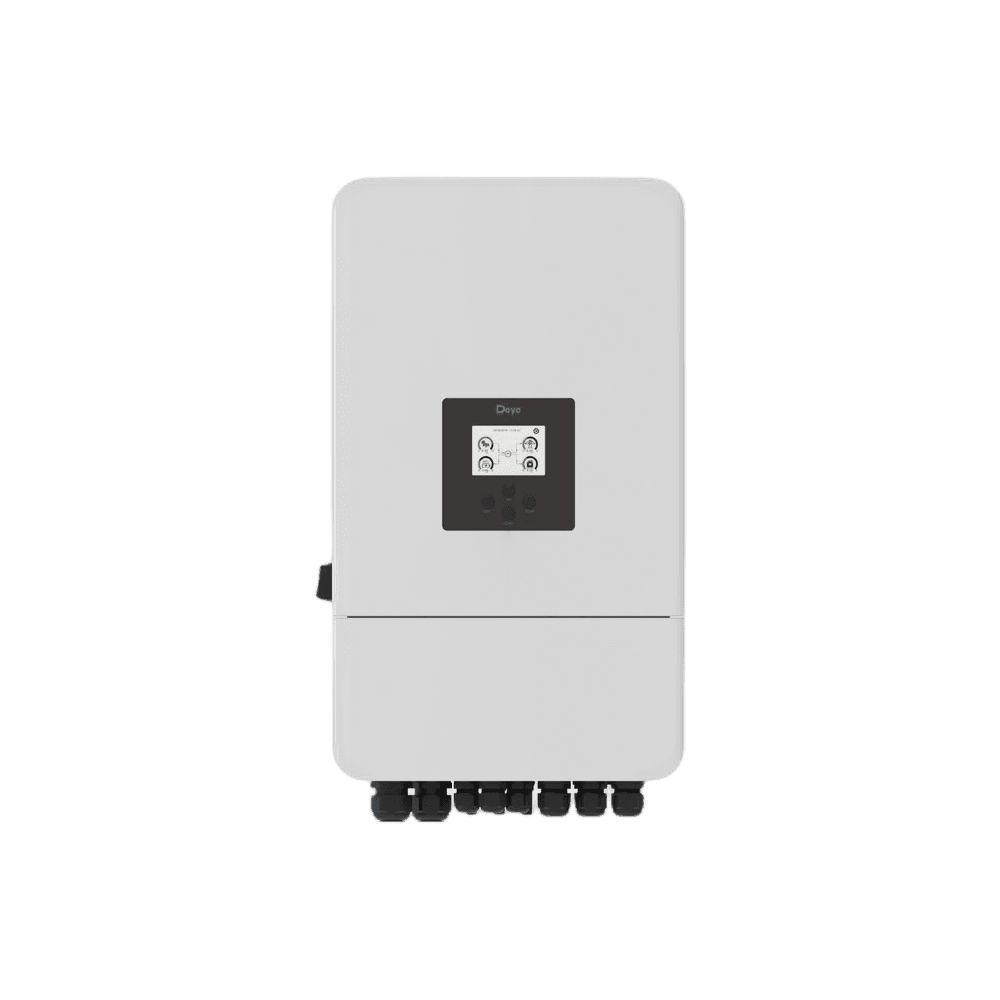
That tells us a 5 kW inverter is undersized for this villa. An 8 kW Deye SUN-8K-SG04LP3 with 3-second peak rating of 16 kW handles it easily.
Step 3 — Choose your inverter rating
Once you know peak load, pick the inverter that covers continuous load with headroom for surges. We recommend the Deye SG04LP3 series for almost all Saudi residential applications because it pairs IP65 protection, 60 °C operating range, and generator-input capability with a wide kW range.
| Saudi villa profile | Daily kWh | Peak load | Inverter recommendation |
|---|---|---|---|
| Apartment / small villa | < 50 | < 4 kW | Deye SUN-5K-SG04LP1 (single-phase 5 kW) |
| 3-bedroom, 2 ACs | 50–80 | 4–6 kW | Deye SUN-6K or SUN-8K-SG04LP3 |
| 4–5 bedroom, 3–4 ACs | 80–150 | 7–10 kW | Deye SUN-10K or SUN-12K-SG04LP3 |
| Large villa + pool + EV | 150–270 | 10–15 kW | Deye SUN-15K or SUN-16K-SG04LP3 |
| Compound | 270+ | 15+ kW | Multiple SUN-12K parallel, or SUN-30K / SUN-50K three-phase |
Single-phase vs three-phase: if your SEC connection is three-phase (most modern villas above 4-bedroom), use a three-phase inverter. Mismatched phases will trip protection on the SEC side.
Step 4 — Size your PV (panel) array
The DC/AC ratio — total panel watt-peak divided by inverter watt rating — should be 1.1 to 1.3 for Saudi conditions. Going higher (1.4+) wastes panel investment because the inverter clips on peak summer days. Going lower (< 1.1) means you generate less than the inverter could handle.
Example for an 8 kW Deye hybrid:
8 kW × 1.2 ratio = 9,600 Wp panel array ≈ 22 panels at 450 Wp each
A villa rooftop in Saudi Arabia typically holds 18–32 panels comfortably depending on layout, so this is achievable on most homes.
📞 Want a roof-fit check? Send a satellite photo of your roof to WhatsApp +971 4 255 0887. We mark up panel placement and confirm clearance.
Step 5 — Size your battery
Battery capacity is sized by how many hours of evening / night autonomy you want.
For a Saudi villa, a useful framing is: how much energy do you use between sunset and sunrise (roughly 6 pm to 6 am) in summer?
In a typical 4-bedroom villa in July:
- 3 ACs from 6 pm to 11 pm: 3 × 1.8 × 5 = 27 kWh
- 2 ACs from 11 pm to 6 am: 2 × 1.5 × 7 (cycling) = ~12 kWh (cycling reduces continuous load)
- Other loads (fridge, lights, electronics): ~6 kWh
Total evening / overnight load: ~45 kWh.
If you want full overnight backup, you'd need 45 kWh of usable battery — that's more than most homes need or can justify. Most homeowners pick partial backup: enough battery to cover the AC peak from 6 pm to 11 pm and run essentials overnight.
| Battery target | Capacity needed | Cost (SAR, 2026) |
|---|---|---|
| Essentials only (lights + fridge + 1 AC overnight) | 5–8 kWh | 7,000 – 12,000 |
| Comfort backup (full evening + reduced night) | 10–15 kWh | 14,000 – 22,000 |
| Near-full off-grid evening | 20–25 kWh | 28,000 – 38,000 |
| Multi-day autonomy (rare in KSA grid) | 40+ kWh | 55,000+ |
The Deye AI-W5.1-B LiFePO₄ batteries are modular — you can start at 10 kWh and add modules as your needs grow. That's our usual recommendation: don't over-buy on day one.
Step 6 — Add generator integration if relevant
Many Saudi villas already have a backup diesel generator from before the SEC reliability improvements. The Deye SG04LP3 series accepts AC2 generator input with auto-start trigger — meaning the inverter will only start the generator if battery falls below your defined threshold AND the grid is down. In practice this drops generator runtime by 70–85% versus running it directly during outages.
Sizing rule: generator kVA should be 1.0–1.5× the inverter continuous kW rating. An 8 kW Deye hybrid pairs cleanly with a 10–12 kVA diesel genset.
Worked example: 4-bedroom villa in Riyadh
Let's run a real sizing for a 4-bedroom villa in north Riyadh:
Inputs:
- Summer monthly SEC bill: 2,200 SAR (about 3,800 kWh / month, ~127 kWh/day)
- Three split ACs (1.5 ton each), refrigerator, freezer, electric water heater, washing machine
- Existing 13 kVA diesel generator
- Three-phase SEC connection
- Roof: 75 m² usable, south-facing
Sizing output:
- Inverter: Deye SUN-12K-SG04LP3 (12 kW three-phase hybrid)
- Panels: 32 × 450 Wp = 14.4 kWp (DC/AC = 1.2)
- Battery: 15.36 kWh (3 × 5.12 kWh AI-W5.1-B modules) — covers evening peak
- Generator: existing 13 kVA, integrated as backup-only via AC2 input
- Expected daily generation (May–Sep): 80–95 kWh
- Expected monthly SEC bill after install: 200–400 SAR (down from 2,200)
- Estimated payback: 5.2 years at current tariffs
- System cost: ~62,000 SAR turnkey
Common sizing mistakes to avoid
- Sizing for average load instead of peak. Average tells you energy needs; peak tells you inverter capacity. You need both.
- Assuming all your panels will hit nameplate. In Saudi summer with 50 °C ambient, panels lose 8–12% to temperature. Plan for 88% of nameplate.
- Buying the smallest battery to "save money." The marginal cost of adding 5 kWh on day one is much lower than retrofitting later.
- Mismatching phases. A single-phase inverter on a three-phase connection (or vice versa) triggers SEC protection trip.
- Ignoring future loads. Adding an EV charger or a fourth AC after install? Plan for it now.
What to do next
🔧 Technical references: Complete Deye Error Code Troubleshooting Guide · Deye Hybrid Inverter Installation Guide for Saudi Arabia
If you've worked through the calculations and want a sanity check, the fastest way is to send your last SEC bill — even a screenshot — to our WhatsApp. We'll come back with a sized system, three battery options, and an indicative quote within an hour.
For the broader picture on which brand and model to choose, head to our Best Solar Inverter for Saudi Homes 2026 buyer's guide.
For the regulatory side — net-metering, SEC approval, paperwork — see SEC Net-Metering in Saudi Arabia.
For pricing transparency by system size, 5 / 10 / 20 kW Solar System Cost in KSA breaks it down in SAR.
📞 Free villa sizing in 15 minutes: WhatsApp +971 4 255 0887 · 📧 sales@deyeinverters.net
Frequently Asked Questions
What size hybrid inverter do I need for a 4-bedroom villa in Saudi Arabia?
How many solar panels do I need for a Saudi villa?
Is a 5 kW solar inverter enough for a Saudi villa?
How much battery do I need with my solar inverter in Saudi Arabia?
Can I run my AC entirely off solar in Saudi Arabia?
Does Deye's 8 kW hybrid inverter work with my SEC three-phase connection?
Ready for a personalized quote?
WhatsApp us — average reply time under 15 minutes.
Related Products
Related Articles
Best Solar Inverter for Saudi Homes 2026: Complete Buyer's Guide
What Is a Solar Inverter? One Device, Four Names, and What the Spec Sheet Says
Why Deye Inverters Survive Saudi Heat: IP65, 60 °C Tolerance & Desert-Tested Performance