Programming a Deye is not a list of steps, it is a set of limits the record states. Of 134 inverter records, 52 accept a battery and 49 of those state six programmable charge/discharge periods. Here are the figures.
“How do I program my inverter?” is a question with a sharper second half than it looks: what can actually be set on this machine, and what limit will the setting refuse to cross no matter what you type into it? This page answers the second half, because that is the half our records can answer. The 134 Deye inverter records we publish state the bounds of every setting — the grid voltage window, the battery voltage range, the maximum charge current, the number of programmable periods — and not one of them states a menu number or a screen path. So every figure here is copied off a row; anything you do not find here, we did not invent.
We are an authorised Deye distributor, and this page is written from the spec records we publish — 134 Deye inverter records — not from a user manual. If you have a specific model code in front of you and want its numeric limits before you touch the screen, send it on WhatsApp +971 4 255 0887 or by email to sales@deyeinverters.net.
Three sides get set, not one
Every setting on a solar inverter belongs to one of three sides: the grid side, the battery side and the array side. The order is not arbitrary. The grid side is governed by rules you do not choose, the battery side by what you actually installed, and the array side is not a set of settings at all but a set of design limits decided before the electrician reaches the roof.
Before those three, though, comes a question that outranks them: is your machine programmable in this sense at all? Of the 134 records, 52 state a battery type and the other 82 read “Not Applicable” on the battery row — the 70 string inverters and the 12 microinverters. A string inverter is configured on the grid side alone: no charge periods, no charge current, no generator, no AC coupling. Those are not four hidden settings; they are four rows that say Not Applicable.
| Family | Records | Battery type row | Programmable periods | Generator support |
|---|---|---|---|---|
| String (G) | 70 | Not Applicable | Not Applicable | Not Applicable |
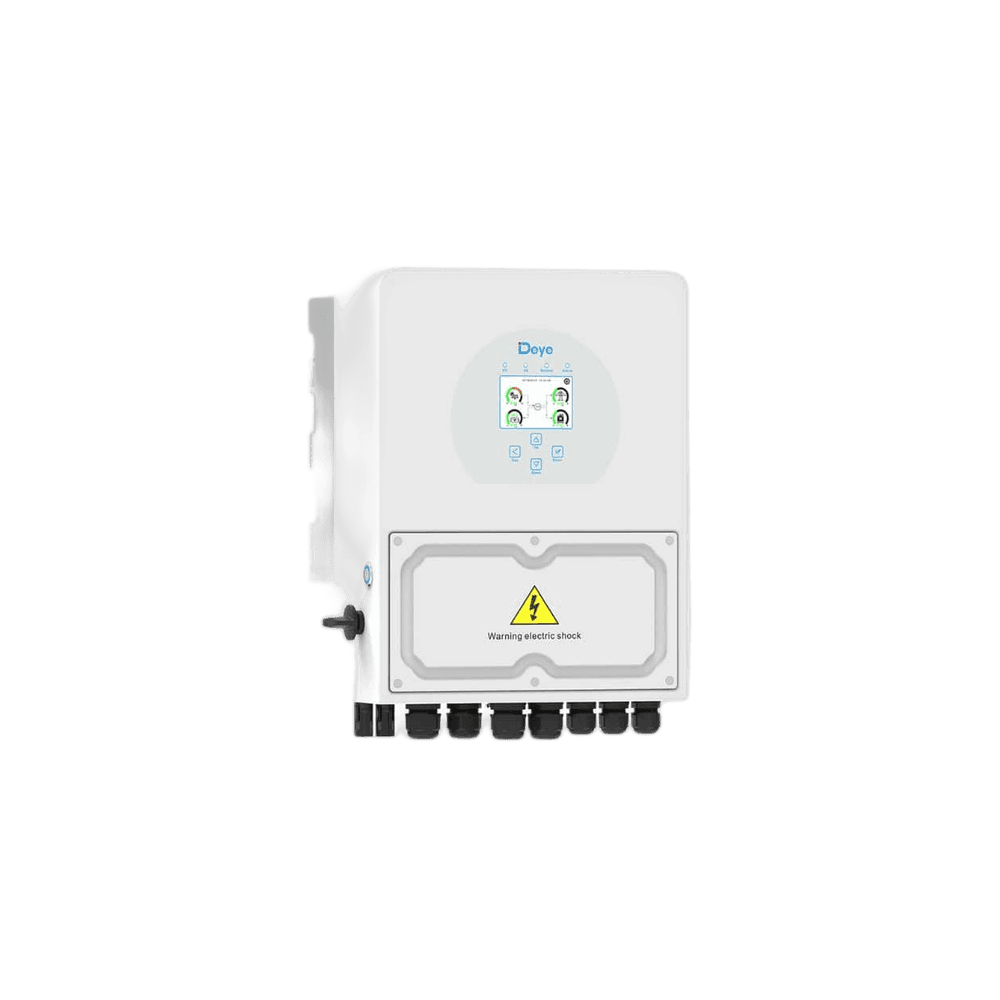
| Hybrid (SG) | 49 | Stated | 6 | Yes (Diesel) |
| Micro (M) | 12 | Not Applicable | Not Applicable | Not Applicable |
| Off-Grid (OG) | 3 | Stated | Not Stated | Yes (Diesel) |
The grid side: one standard you pick, two windows you do not
The first thing configured on any grid-connected installation is the grid standard. The grid regulation row across our records names 15 distinct standards over the whole range: IEC 61727 and IEC 62116 on 131 records, then CEI 0-21, CEI 0-16, EN 50549, EN 50549-1, NRS 097, RD 140, UNE 217002, OVE-Richtlinie R25, G98, G99, VDE-AR-N 4105, VDE-AR-N 4110 and NC RFG. Not one of them is a Gulf standard, and we will not pretend otherwise. Which standard your electricity provider accepts is held by the provider and your licensed contractor, not by a spec sheet.
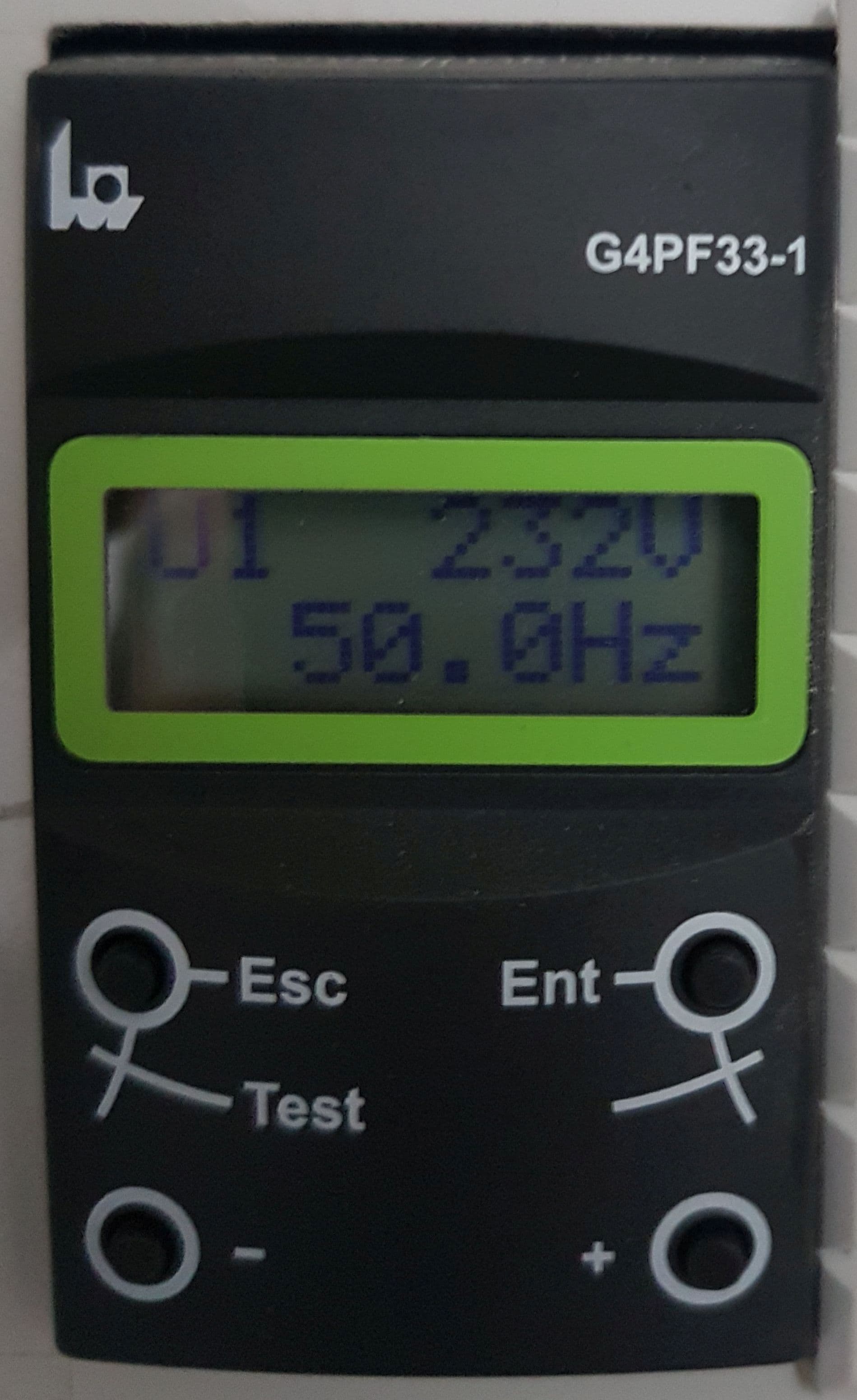
Underneath the standard sit two windows written out in numbers on the same records. The first is the AC voltage tolerance relative to nominal: 0.85–1.1 on 131 of the 134 records, meaning the machine runs between 85 % and 110 % of nominal voltage and disconnects outside it. The second is the rated grid frequency, written “50/45-55, 60/55-65” on those same 131: fifty hertz with a 45–55 window, or sixty with a 55–65 window. The three exceptions are the off-grid SUN-3.6K-OG01LP1, SUN-5K-OG01LP1 and SUN-6K-OG01LP1, which state “50, 60” with no tolerance window and no nominal range at all, because they never synchronise to a network.
Two more rows on this side are configurable. Power factor is stated on every record: 0.8 leading to 0.8 lagging on 119 of them, and 0.9 to 0.9 on the 12 microinverters. And zero export support reads Yes on 70 records — all of them string inverters — and is left unstated on the other 64. An unstated row is not a No; it is a capability that was never published, which is why we will not sell it to you.
The battery side: the setting that damages something if you get it wrong
On the 52 records that accept a battery, the first thing configured is the battery type. The row comes in exactly two forms: “Lead-acid or Lithium-ion” on 35 records and “Lithium-ion” on 17. The first means the choice is yours; the second means the choice was made before you opened the menu.
Then battery voltage, which separates two families that have nothing in common except the word hybrid. Thirty-four records state a 40–60 V range and one states 20–30 V — that is SUN-3K-SG04LP1-24 — and those are the low-voltage models. Against them, eight records state 160–700 V, five state 160–800 and four state 160–1000: that is the high-voltage family.
The whole difference between them shows up in one row: maximum charge current, the ceiling your charge-current setting cannot cross however you set it. On the low-voltage SUN-12K-SG04LP3 the record says 240 A; on the high-voltage SUN-12K-SG01HP3 it says 37 A — and both records state the same rated AC output active power, 12,000 W. The highest figure in the range is 350 A on SUN-20K-SG05LP3 and the lowest is 30 A on SUN-5K-SG01HP3 and SUN-6K-SG01HP3. One more figure is worth saying out loud: maximum discharge current equals maximum charge current on all 52 records, without a single exception.
Then a row that will relieve anyone who thinks they must draw a charge curve by hand: the charging strategy row reads “Self-adaption to BMS” on all 52 records. The curve comes from the battery management system, not from a number you type. Alongside it, battery parallel support reads Yes on all 52, and the number of battery inputs is 1 on 35 records and 2 on 17.
| Model | Battery voltage range | Max charge current | Peak power | Max continuous AC pass-through | Periods |
|---|---|---|---|---|---|
| SUN-3K-SG04LP1-24 | 20–30 V | 140 A | 2× for 10 s | 35 A | 6 |
| SUN-5K-SG04LP1 | 40–60 V | 120 A | 2× for 10 s | 40 A | 6 |
| SUN-12K-SG04LP3 | 40–60 V | 240 A | 2× for 10 s | 45 A | 6 |
| SUN-12K-SG01HP3 | 160–700 V | 37 A | 1.5× for 10 s | 80 A | 6 |
| SUN-20K-SG05LP3 | 40–60 V | 350 A | 2× for 10 s | 70 A | 6 |
| SUN-6K-OG01LP1 | 40–60 V | 135 A | 2× for 10 s | 35 A | Not Stated |
The six periods
The charge/discharge time periods row reads 6 on 49 records — every hybrid — and is unstated on the three OG01LP1 units. Six periods means six time windows in the day, each able to carry its own behaviour. That number is what our records publish, and it is all they publish on the subject: what you put inside those windows is a tariff-and-household decision rather than a spec-sheet one, and we gave it a page of its own in the battery scheduling and time-of-use guide.
Generator input and AC coupling
Generator support reads “Yes (Diesel)” on the same 52 records that accept a battery. But the generator input current — the number you actually need to size a breaker — is stated on only three records: the three OG01LP1 units, at 35 A, which is exactly equal to the maximum continuous AC pass-through on those same units. The 49 hybrid records leave the row unstated, and we will not fill it from memory: that figure comes from your contractor and the generator's own panel, not from this page.
AC coupling support reads Yes on 49 records — all the hybrids — and is unstated on the three OG01LP1 units. Parallel units are stated on 64 records: ten units on 34 hybrid records, sixteen units on 15 hybrid records and on the three OG01LP1 units, while the microinverters range from 3 to 17 depending on model. The 70 string inverters read Not Applicable on that row.
The array side: three numbers settled before any setting
There is no setting to type on the array side. There are three numbers that decide the shape of the string before installation, and stepping outside them means the machine will not start or will not track. The first is startup voltage, the voltage at which the inverter wakes up, and it takes seven values across the range: 20, 80, 125, 140, 160, 180 and 250 V. The second is the MPPT voltage range, the window it tracks inside. The third is maximum PV input voltage, the absolute ceiling — crossing that one is damage, not a mistake.
| Records | Startup voltage | MPPT voltage range | Max PV input voltage | Example |
|---|---|---|---|---|
| 32 | 80 V | 70–500 V | 550 V | SUN-1.5K-G04P1 |
| 21 | 250 V | 200–1000 V | 1100 V | SUN-120K-G01P3 |
| 18 | 125 V | 150–425 V | 500 V | SUN-5K-SG04LP1 |
| 17 | 180 V | 150–850 V | 1000 V | SUN-12K-SG01HP3 |
| 12 | 160 V | 200–650 V | 800 V | SUN-12K-SG04LP3 |
| 12 | 20 V | 25–55 V | 60 V | SUN-M100G4 |
| 10 | 140 V | 120–1000 V | 1100 V | SUN-10K-G06P3 |
| 7 | 250 V | 200–850 V | 1000 V | SUN-100K-G03 |
| 5 | 160 V | 160–650 V | 800 V | SUN-14K-SG05LP3 |
Six things to check before you blame the settings
When nothing works, the likeliest cause is not a wrong setting but a crossed limit. All six checks below are numbers you read off your model's record and then measure against reality, in this order:
- String voltage below the startup voltage: early morning or under heavy cloud the machine is not faulty, it simply has not woken up.
- String voltage outside the MPPT voltage range: inside the window it tracks, below it produces less than it should, and above the maximum PV input voltage it must not be energised at all.
- Grid voltage outside 0.85–1.1 of nominal: that window is stated on 131 records, and disconnecting outside it is correct behaviour rather than a fault.
- Frequency outside 45–55 Hz or 55–65 Hz: on a weak rural feeder this is far more common than people expect.
- Ambient above 45 °C: 113 records state that power derating begins at 45 °C, so a July midday dip is published behaviour, not a defect. Twenty-one records state no derating start temperature at all — 15 string and 6 micro — and we will not guess one for them.
- Battery voltage outside the range on the record: 20–30, 40–60, 160–700, 160–800 or 160–1000 V depending on model, and nothing else.
And if there is a code on the screen, the checks above stop and the road starts at the code itself: Deye inverter error codes by model.
What our records do not state — and we will not write
This page is built on 134 records, and they do not state menu numbers, screen paths, factory default values, the installer password, firmware versions or a sequence of presses that reaches a given setting. We will not write any of that from memory just to make the page longer. What the records do state is the limits, and the limits are the part that ruins an installation when they are crossed; a wrong menu path is a mistake you undo by stepping back.
Two specific gaps deserve naming rather than hiding. Generator input current is unstated on 49 hybrid records, and the derating start temperature is unstated on 21 records. An unstated row is not a zero and not a denial; it is a number we do not hold, so we do not publish it.
Where the programming happens: the screen and the interface
The screen itself is not one thing across the range, and that changes the shape of the job before its content. The display row reads “Colorful Touch LCD” on 18 records, “LCD” on 20, “LCD 240 x 160” on 15, “LCD+LED” on 9 and “LCD1602” on 3; it is unstated on 57 and reads Not Applicable on 12 — the microinverters, which have no screen at all and are configured entirely over Wi-Fi.
Communication interfaces come in only five combinations: RS485 and RS232 on 52 records, RS485/RS232/CAN on 30, RS485/CAN/Wi-Fi on 22, RS485/RS232/Wi-Fi/LAN on 18, and Wi-Fi alone on 12. CAN specifically is what makes the battery-management conversation possible, and it is present on 52 records. Remote monitoring modes are stated on 104 records: GPRS, Wi-Fi, Bluetooth and 4G with optional LAN on 96, and the same set without LAN on 8.
If you would rather start from your model than from the general rule, send the model code and we will send back its limit rows exactly as the record holds them — voltage range, charge-current ceiling, number of periods, and what is Not Stated on it — on WhatsApp +971 4 255 0887 or at sales@deyeinverters.net.
Frequently Asked Questions
How do I program a solar inverter?
How many charge and discharge periods can a Deye hybrid inverter be programmed with?
What grid voltage and frequency range do Deye inverters accept?
What should I set the battery charge current to?
Why does my inverter not start early in the morning?
Is every Deye inverter programmable?
Ready for a personalized quote?
WhatsApp us — average reply time under 15 minutes.