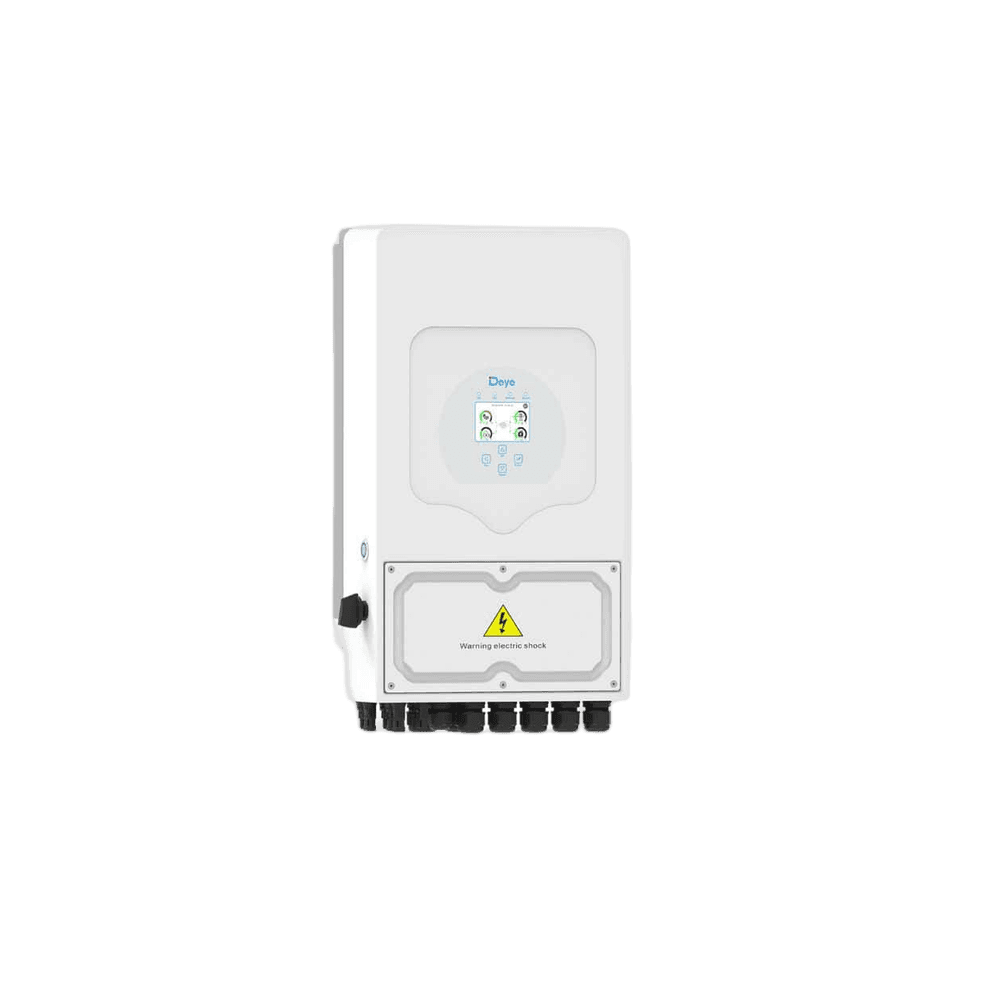
Do Solar Inverters Lose Power in Abu Dhabi's Summer Heat?
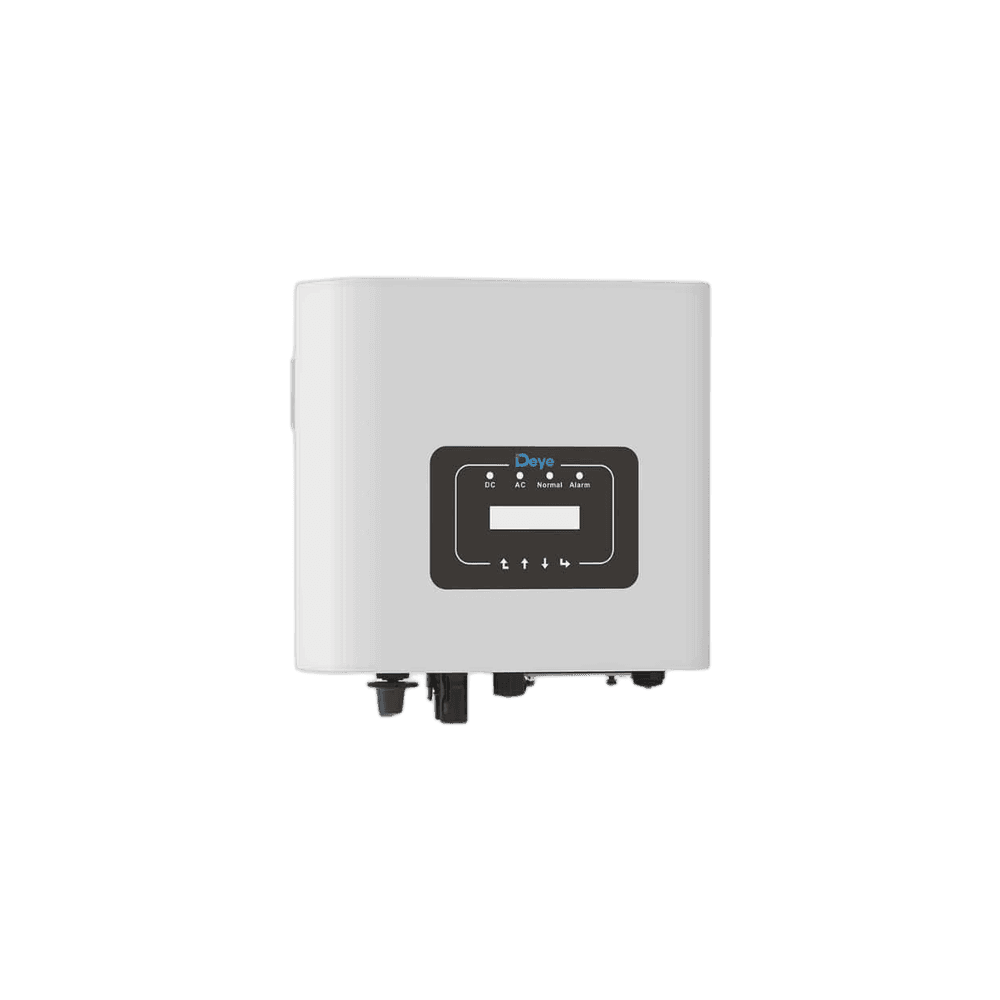
113 of 134 Deye inverter records state output derates from 45 °C, and 30 units are rated to 65 °C ambient. What that means on an August rooftop, and how shade and clearance change it.
You are looking at a roof in Abu Dhabi in August and thinking the obvious thing: nothing survives up there. So does the inverter give up in the middle of the afternoon, exactly when the air conditioning wants everything the panels can make?
It does not give up. It backs off — and the temperature at which it starts backing off is printed in the technical record for every unit, so this is a question you can answer with a number rather than a worry. Across the 134 Deye inverter records, 113 state that output begins derating at 45 °C, and the ambient ranges run to 60 °C or 65 °C depending on the family.
We are an authorised Deye distributor. Ready to buy? Pick the model in the catalogue and order it online.
Products mentioned in this article
Deye 1 kW Single-Phase String Solar Inverter SUN-1K-G04P1-EU-AM1

- Rated AC Output Active Power
- 1000 W
- Max. Efficiency
- 97.3 %
- Number of MPPTs
- 1
- Grid Connection Form
- L+N+PE
Price incl. VATAED 1,657
Deye 2 kW Single-Phase String Solar Inverter SUN-2K-G04P1-EU-AM1
- Rated AC Output Active Power
- 2000 W
- Max. Efficiency
- 97.3 %
- Number of MPPTs
- 1
- Grid Connection Form
- L+N+PE
Price incl. VATAED 1,657
Deye 3 kW Single-Phase String Solar Inverter SUN-3K-G04P1-EU-AM1
- Rated AC Output Active Power
- 3000 W
- Max. Efficiency
- 97.5 %
- Number of MPPTs
- 1
- Grid Connection Form
- L+N+PE
Price incl. VATAED 1,657
Deye 4.6 kW Single-Phase String Solar Inverter SUN-4.6K-G04
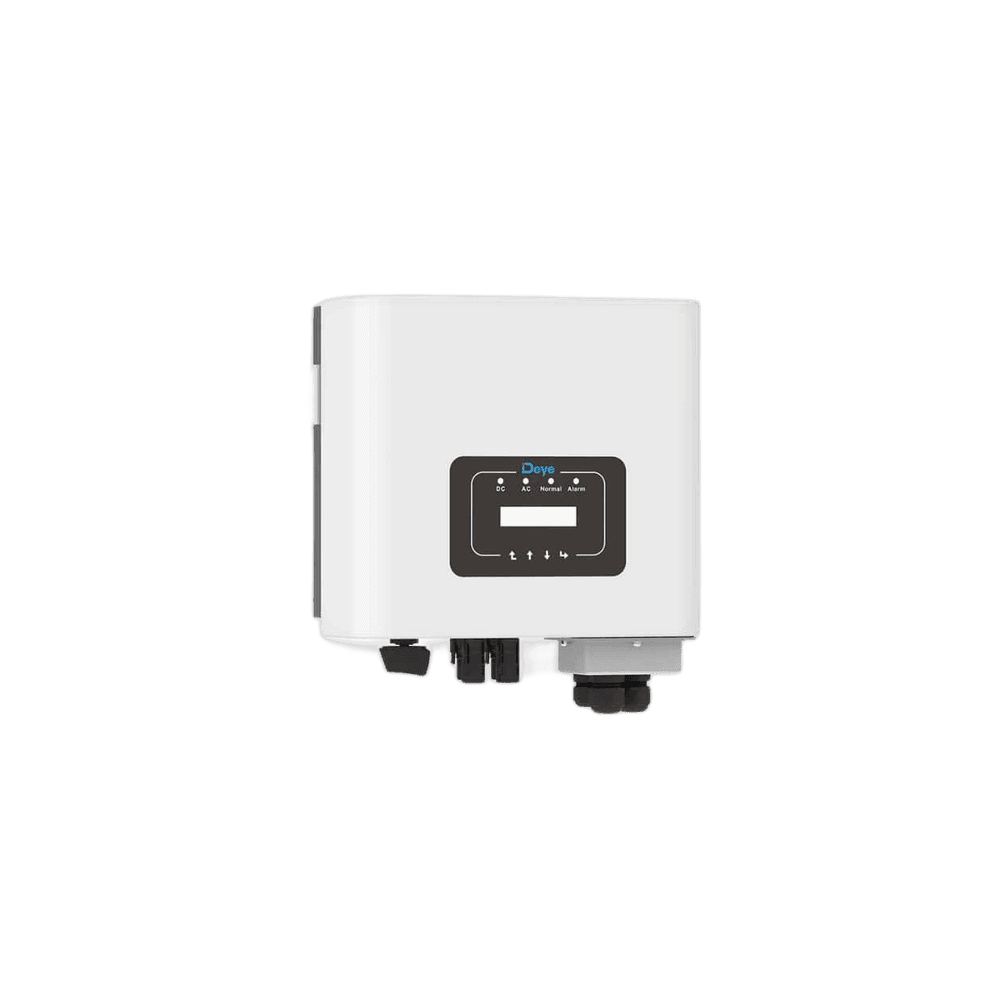
- Rated AC Output Active Power
- 4600 W
- Max. Efficiency
- 97.5 %
- Number of MPPTs
- 2
- Grid Connection Form
- L+N+PE
Price incl. VATAED 2,170
Deye 5 kW Single-Phase String Solar Inverter SUN-5K-G04
- Rated AC Output Active Power
- 5000 W
- Max. Efficiency
- 97.5 %
- Number of MPPTs
- 2
- Grid Connection Form
- L+N+PE
Price incl. VATAED 2,170
Deye 6 kW Single-Phase String Solar Inverter SUN-6K-G04
- Rated AC Output Active Power
- 6000 W
- Max. Efficiency
- 97.5 %
- Number of MPPTs
- 2
- Grid Connection Form
- L+N+PE
Price incl. VATAED 2,170
Do solar inverters lose output in Abu Dhabi's summer heat?
Yes, above a stated temperature — and that is designed behaviour, not a fault. 113 of the 134 Deye inverter records state that output begins derating at 45 °C ambient. Derating means the unit reduces the power it converts so its internal components stay inside their limits, and it keeps running while it does so. The alternative design, which you do not want, is a unit that holds full output until something inside gives up and it trips. The number that decides how much you lose is not the forecast temperature for Abu Dhabi; it is the temperature of the air actually touching the inverter's case. A unit bolted to an unshaded west-facing wall sits in air far hotter than the shade reading, and that gap is the part you control.
What derating is, and why it is a feature
An inverter converts DC into AC and loses a small fraction of the energy as heat while doing it. That heat has to leave the case. When the surrounding air is already hot, less heat leaves, the internals climb, and the only two honest responses are to reduce throughput or to stop.
Deye's records choose the first. The derating column names the ambient temperature at which the reduction begins, and the operating-temperature column names the ambient temperature beyond which the unit is no longer rated to run at all. The gap between those two figures — 45 °C to 60 °C, or 45 °C to 65 °C — is the band in which the inverter is still working, still exporting and still charging, just not at its nameplate maximum.
This is worth restating because it is the source of most bad advice about Gulf installations: an inverter that derates in August is doing its job. An inverter that trips in August was mounted badly, or was the wrong unit for the position.
The two temperature numbers on every Deye record
Every family in the range publishes both. Here is the whole fleet:
| Family | Records | Ambient operating range | Output derates from | Enclosure |
|---|---|---|---|---|
| Hybrid (SG) | 49 | -40 to 60 °C | 45 °C, all 49 | IP65 |
| String (G) | 70 | -25 to 60 °C on 52, -25 to 65 °C on 18 | 45 °C on 55 of 70 | IP65 |
| Microinverter (M) | 12 | -40 to 65 °C | 45 °C on 6 of 12 | IP67 |
| Off-grid (OG) | 3 | -40 to 60 °C | 45 °C, all 3 | IP65 |
Two things fall out of that table. First, the high end of the ambient range is 60 °C on 104 records and 65 °C on 30 — so 30 units carry a five-degree wider ceiling than the rest of the fleet. Second, the derating figure is the same 45 °C almost everywhere it is stated, which means the model choice does not move the point where derating starts. What moves is the headroom above it.
Which Deye units are rated to 65 °C?
Thirty of them, in two groups. The twelve microinverters are all rated -40 to 65 °C. The other eighteen are single-phase string inverters in the G04 family — the small ones — which are rated -25 to 65 °C:
| Model | Rated AC output | Ambient range | Cooling | Weight |
|---|---|---|---|---|
| SUN-1K-G04P1-EU-AM1 | 1,000 W | -25 to 65 °C | Natural | 5.6 kg |
| SUN-2K-G04P1-EU-AM1 | 2,000 W | -25 to 65 °C | Natural | 5.6 kg |
| SUN-3K-G04P1-EU-AM1 | 3,000 W | -25 to 65 °C | Natural | 5.6 kg |
| SUN-4.6K-G04 | 4,600 W | -25 to 65 °C | Natural | 8 kg |
| SUN-5K-G04 | 5,000 W | -25 to 65 °C | Natural | 8 kg |
| SUN-6K-G04 | 6,000 W | -25 to 65 °C | Natural | 8 kg |
| SUN-M100G4-EU-Q0 | 1,000 W | -40 to 65 °C | Natural | 3 kg |
Notice the pattern: every unit with a 65 °C ceiling is naturally cooled. Across the fleet, 59 records state natural cooling, 71 state intelligent air cooling and 4 state smart cooling. A naturally cooled unit has no fan to fail in a dust-heavy summer, which on an Abu Dhabi roof is worth as much as the extra five degrees.
Mounting is the cheapest heat fix on an Abu Dhabi roof
You cannot change 45 °C. You can change what the air around the inverter is doing, and it costs a bracket and an afternoon.
- Put it in shade. Under the array, on a north-facing wall, inside a ventilated plant space — anywhere the case is not taking direct sun on top of an already hot day.
- Keep clearance on all four sides and above. An inverter pushed into a corner re-breathes its own exhaust, and the air touching the case is then hotter than the air in the room.
- Get it off the roof deck. A membrane or a concrete slab in Abu Dhabi radiates upward all afternoon and again into the evening. A wall or a frame that lifts the unit clear of that surface is a real gain.
- Do not box it in. A cabinet with no through-flow is an oven with a door, whatever the wall material is.
- Prefer the shaded west side to the sunny west side. If the only wall available faces the afternoon sun, add a shade hood — it is the smallest amount of money in the whole project.
None of this is exotic. It is the difference between an inverter whose surrounding air stays near the shade temperature and one sitting in a pocket of air well above it — and the second one crosses 45 °C on days the first one does not.
Humidity, the coast, and what the records say
Abu Dhabi is not only hot; near the water it is humid, and the two together are harder on electronics than either alone. On this the fleet is uniform: all 134 Deye inverter records state a permissible ambient humidity of 0 to 100 %.
Ingress protection backs that up. 122 records are IP65 — dust-tight and protected against water jets — and the 12 microinverters are IP67, which adds temporary immersion. On a coastal roof, choose an installation position that lets condensation drain and does not trap salt-laden air against the case, and keep the cable glands as specified rather than improvised.
One column that does not bind in Abu Dhabi
Permissible altitude is stated on every record — 2,000 m on 63 units, 3,000 m on 33 and 4,000 m on 38 — and it is the one heat-adjacent figure that is never the constraint here. Abu Dhabi is essentially at sea level. Mention it only so you can stop worrying about it: if an installer quotes altitude derating on an Abu Dhabi rooftop, that is a figure borrowed from a different market.
Efficiency, read next to heat
Two efficiency figures appear on the records: maximum efficiency and European efficiency, the second being a weighted figure across a range of loads. Across the Deye fleet, maximum efficiency runs from 96.5 % on the microinverters up to 98.8 % on the largest string units, with 48 records at 97.6 %.
Those are conversion figures, not heat figures, and it is worth keeping them apart. A 98.8 % unit in a badly ventilated corner will produce less on an August afternoon than a 97.5 % unit in shade with clearance. Efficiency is what the unit does with the energy it converts; mounting is what decides how much it is allowed to convert.
Where to get the Abu Dhabi connection answer
We publish equipment figures because they are ours to publish. Grid connection in Abu Dhabi is not: the approval route, the contractor enrolment and any fees are held by ADDC — Abu Dhabi Distribution Company — and its enrolled contractors, and they are the ones to quote. Ask them for the process and the cost, then send us what they told you and we will match a model to the connection you have actually been granted.
Order online: every model in the catalogue shows its price, and checkout takes a minute.
Frequently Asked Questions
At what temperature does a Deye inverter start losing output?
Which Deye inverters are rated for 65 °C?
Will my inverter shut down on a hot Abu Dhabi afternoon?
Does shading the inverter really make a difference?
Is humidity a problem for inverters on the Abu Dhabi coast?
Does altitude derating apply in Abu Dhabi?
- #Abu Dhabi
- #inverter derating
- #summer heat
- #operating temperature
- #ADDC
- #rooftop solar
- #IP65
Ready to order?
Every unit in the catalogue carries its price — add it to the cart and order online, then collect it from our store in Dubai or Riyadh.